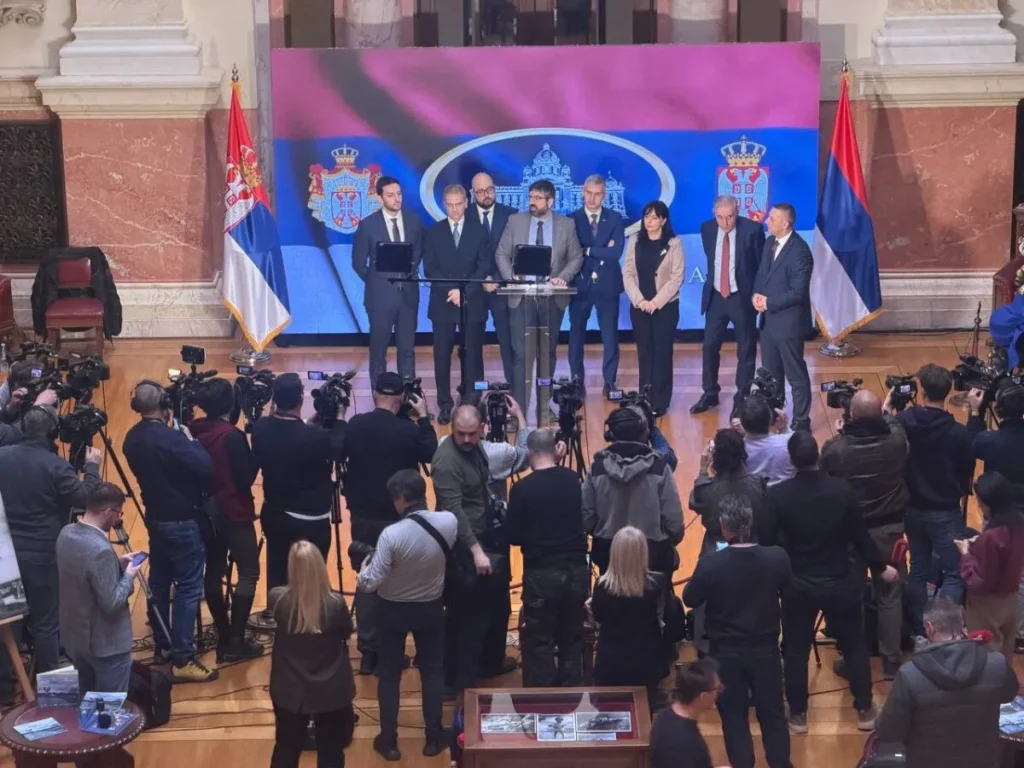

Following their meeting with the Vice President of the National Assembly and the Chair of the Committee on European Integration, the European Parliament delegation also met with representatives of the opposition.
At the meeting, the opposition called on the EU to monitor local elections in Serbia and to redirect funds from accession instruments away from government institutions that misuse them toward civil society organizations and media working in the public interest. Earlier, they demanded that the EU impose personalized, targeted sanctions against individuals within the government responsible for repression.
Mašina spoke with three members of parliament about their impressions of the meeting.
Grbović: EU funds are being used to further repression in Serbia
Pavle Grbović, president of the Free Citizens’ Movement (PSG) and a member of parliament, told Mašina that members of the delegation were receptive to their proposal regarding redirecting EU funds.
“Today at the meeting, we proposed that all funds normally allocated to the state and its institutions be redirected to civil society organizations and free media that, in essence, best demonstrate and defend European values in Serbia. This is not a novelty, nor something we invented or that has never happened before. It is an approach that, for example, the Swedish government applied toward the government of the Republic of Serbia due to constant violations of democratic procedures. It is also a principle, or approach, that the European Commission is already applying in Georgia. So, this is something that exists, and this proposal was met with understanding, I would even say approval, by the majority of the delegation. It is a proposal and an idea that is already being seriously considered within EU institutions,” Grbović said.
The MP and PSG party president added that MEPs are aware that funds reaching institutions are being misused. Grbović says the EU mission was told that the financial support the government receives is being used to strengthen its repressive apparatus, bolstering the police so they can more effectively break up demonstrations and instill fear among Serbia’s population.
“This is the police that beats students, that wiretaps and surveils the opposition, journalists, civil society, and everyone else. Simply put, putting money into the hands of this regime and its institutions that will abuse it is a rather negative advertisement for the European Union itself. Regardless of the fact that the funds Serbia receives are extremely small, far smaller than what many other countries in the region receive, let alone EU member states, and that Serbia can no longer access many of those funds due to the destruction of democracy. But even that loose change, from their perspective, which ends up in the hands of this regime, is enough to impose and maintain a reign of fear in Serbia,” Grbović concluded.
Lazović: Local elections were a significant topic of the meeting
Radomir Lazović, co-chair of the Green–Left Front, told Mašina that a shift in the European Union’s attitude toward Serbia’s authorities is already visible.
“What is different is that different bodies are reacting differently. Where I think we have achieved the greatest success is in the European Parliament. What we expect next is the European Commission. On the other hand, the ruling Serbian Progressive Party is not sitting idly by. They have now scattered to find some kind of foothold in one of those bodies so they can present themselves as if they still have support,” Lazović said.
Lazović added that upcoming local elections were an important topic discussed in the meeting.
“We asked for a mission to come to the local elections that are currently taking place. These are all difficult issues because they generally do not send missions to local elections, but we received assurances that they would try. In addition, we asked that the elections not be recognized if fraud occurs. We already have a European Parliament resolution stating that there was fraud in the previous elections. Now we asked that elections not be recognized if such fraud happens again, and I think that for the first time we have full support for positions we have been expressing for a long time,” Lazović emphasized.
Ćuta: How things develop next also depends on us
Member of parliament and leader of the Ecological Uprising, Aleksandar Jovanović Ćuta, spoke to Mašina about expectations following the meeting with the EP delegation.
“Ursula and Marta Kos and the rest will still kiss Vučić whenever they meet him – whether in Davos or at some other meeting – and the opposition here, along with dissatisfied representatives of the citizens, will continue to say that there are neither human rights—nor even the letter ‘h’ of them. Nor media freedom. This has been going on for a very long time. It is true that for twelve years the European Union has coldly observed a dictator who is dismantling everything that constitutes basic human rights, justice, and the rule of law. What is unimaginable there, he does here, and we keep going in circles. How things develop next also depends on us here – on this uprising, which I hope will deliver results – and it also depends on geopolitical factors, because what is happening to them now is actually the same thing that happened to us” Ćuta said.
According to the MP, we are in a period that “smells like war.”
“That is why I asked Mr. Picula to do everything within his power to choose words carefully, not to use harsh language, so that we never again find ourselves in a situation where our children are rolling around in trenches on Balkan battlefields – because both there and here we are seeing a resurgence of outright fascism,” Ćuta stressed.
A.G.A.


