“EU Funds Are Fueling Repression in Serbia”: European Parliament meets with Serbian Opposition

During its fact-finding visit to Serbia, a delegation of the European Parliament met with representatives of the Serbian opposition. Following the meeting, Mašina spoke with three opposition members of parliament, who said the talks focused on election integrity, the misuse of EU accession funds, and what – if anything – can be expected to change in the EU’s relations with the Serbian government.

During its fact-finding visit to Serbia, a delegation of the European Parliament met with representatives of the Serbian opposition. Following the meeting, Mašina spoke with three opposition members of parliament, who said the talks focused on election integrity, the misuse of EU accession funds, and what – if anything – can be expected to change in the EU’s relations with the Serbian government.

Von der Leyen Faces Pressure Over Serbia Visit

European Commission President Ursula von der Leyen will meet with Serbian President Vučić and Prime Minister Macut tomorrow during her visit to the Western Balkans. European political parties, media rights organizations, and Serbian citizens have called on von der Leyen to take a stand in support of those protesting against the government’s corruption and repression. Von der Leyen is visiting Serbia as part of her tour of the Western Balkans, which also includes Albania, Montenegro, Bosnia and Herzegovina, and Kosovo.

European Commission President Ursula von der Leyen will meet with Serbian President Vučić and Prime Minister Macut tomorrow during her visit to the Western Balkans. European political parties, media rights organizations, and Serbian citizens have called on von der Leyen to take a stand in support of those protesting against the government’s corruption and repression. Von der Leyen is visiting Serbia as part of her tour of the Western Balkans, which also includes Albania, Montenegro, Bosnia and Herzegovina, and Kosovo.

military ships

Show of Force: Government Holds Military Parade in Belgrade

Amid the ongoing social crisis in Serbia, which has lasted for over ten months, the Vučić government has decided to hold the largest military parade in the country’s history. According to retired military officer Petar Bošković, who spoke with Mašina, despite the enormous amount of resources spent on this parade, it would be incorrect to assume that it will be the best ever.

Amid the ongoing social crisis in Serbia, which has lasted for over ten months, the Vučić government has decided to hold the largest military parade in the country’s history. According to retired military officer Petar Bošković, who spoke with Mašina, despite the enormous amount of resources spent on this parade, it would be incorrect to assume that it will be the best ever.

Clashes in Novi Sad

Students’ Analysis Finds Police Used More Dangerous Gas Against Protestors

An independent laboratory analysis conducted by students of the Faculty of Sciences (PMF) in Novi Sad shows that at a protest on September 5, police officers deployed chlorobenzylidenemalononitrile, known as CN gas. CN gas is a more dangerous variant than the usual tear gas, chloroacetophenone which is known as CS gas.

An independent laboratory analysis conducted by students of the Faculty of Sciences (PMF) in Novi Sad shows that at a protest on September 5, police officers deployed chlorobenzylidenemalononitrile, known as CN gas. CN gas is a more dangerous variant than the usual tear gas, chloroacetophenone which is known as CS gas.

Police Crackdown in Novi Sad and the Death of University Autonomy

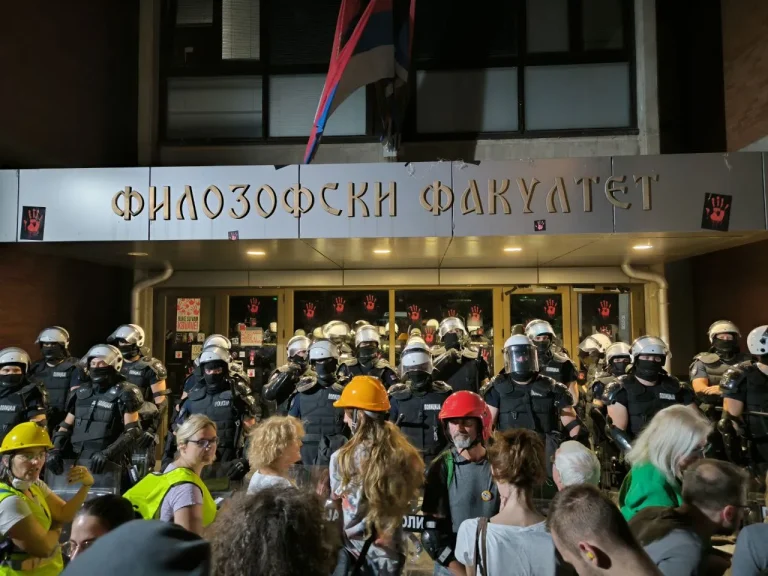
Once again, tear gas, arrests, and beatings characterized Friday's protest in Novi Sad. Under the slogan “Serbia, can you hear us?" protesters marched to the Faculty of Philosophy, where police had been stationed for ten days but have since dispersed. Approximately 20,000 people attended the protest, according to the Archive of Public Gatherings, at which hundreds of people endured beatings, tear gas, and were arrested.

Once again, tear gas, arrests, and beatings characterized Friday’s protest in Novi Sad. Under the slogan “Serbia, can you hear us?” protesters marched to the Faculty of Philosophy, where police had been stationed for ten days but have since dispersed. Approximately 20,000 people attended the protest, according to the Archive of Public Gatherings, which has catalyzed a new wave of protests including one today called by students today in downtown Belgrade.

Foto: studenti u blokadi

Between Protest and the Polls: Serbian Youth Demand Change

Almost 90 percent of young people in Serbia support student protests and university blockades, and more than 90 percent would vote in parliamentary elections if they were held next week, according to the Alternative Report on the Position and Needs of Youth 2025. However, 62 percent believe that elections are neither free nor fair, while as many as 95 percent negatively assess the government’s response to student demonstrations.

Almost 90 percent of young people in Serbia support student protests and university blockades, and more than 90 percent would vote in parliamentary elections if they were held next week, according to the Alternative Report on the Position and Needs of Youth 2025. However, 62 percent believe that elections are neither free nor fair, while as many as 95 percent negatively assess the government’s response to student demonstrations.

A protester in front of a police cordon

Fear as strategy and Europe’s Passivity: How Global Media Describe the Situation in Serbia

From admiration for the student movement to criticism of nationalist symbols during the Vidovdan protest, foreign media coverage of events in Serbia since November 1 of last year has gone through different phases. Judging by the latest headlines, however, autocrat Aleksandar Vučić is running out of room to maneuver. The country he leads is sinking deeper into chaos, and Europe is being urged to increase pressure on his regime in Belgrade.

From admiration for the student movement to criticism of nationalist symbols during the Vidovdan protest, foreign media coverage of events in Serbia since November 1 of last year has gone through different phases. Judging by the latest headlines, however, autocrat Aleksandar Vučić is running out of room to maneuver. The country he leads is sinking deeper into chaos, and Europe is being urged to increase pressure on his regime in Belgrade.

Clashes in Novi Sad

No, This Is Not a Civil War In Serbia

Recent protests across Serbia have often been described in the media and on social networks as a “civil war.” But political scientists, security experts, and historians interviewed by Mašina explain why the current state in Serbia cannot be described as a civil war, as they address what we are actually witnessing, and what is lies beneath the escalated repression.

Recent protests across Serbia have often been described in the media and on social networks as a “civil war.” But political scientists, security experts, and historians interviewed by Mašina explain why the current state in Serbia cannot be described as a civil war, as they address what we are actually witnessing, and what is lies beneath the escalated repression.

Protest in Belgrade

The road to elections and who’s on it: What’s the status of citizens’ rebellion after eight months of action?

The government’s tactic of pretending not to notice civil rebellion and a comprehensive social and political crisis, i.e. to play the waiting game over a long period of time has, at least it appears so, started to work. Summer’s begun, the intensity of protests has gone down, the students are slowly returning to their academic duties. Despite everything though, small fires of resistance are continuing to ignite, mostly on the local level. What remains is the question of how to continue, that is, how to fulfill the main demand put before the regime – the calling of snap parliamentary elections?

The government’s tactic of pretending not to notice civil rebellion and a comprehensive social and political crisis, i.e. to play the waiting game over a long period of time has, at least it appears so, started to work. Summer’s begun, the intensity of protests has gone down, the students are slowly returning to their academic duties. Despite everything though, small fires of resistance are continuing to ignite, mostly on the local level. What remains is the question of how to continue, that is, how to fulfill the main demand put before the regime – the calling of snap parliamentary elections?

Is this freedom: After everything, where are protesters finding the energy to keep going?

“No one is tired!” can be heard, almost by default, at every protest, blockade or organized action of civil disobedience across Serbia. Citizens, fueled by the student movement’s energy, use this slogan to make it clear to the current regime that no extreme heat, increased repression or eight months of relentless struggle will stop them. The question that remains is – how?

“No one is tired!” can be heard, almost by default, at every protest, blockade or organized action of civil disobedience across Serbia. Citizens, fueled by the student movement’s energy, use this slogan to make it clear to the current regime that no extreme heat, increased repression or eight months of relentless struggle will stop them. The question that remains is – how?

Students Continue Blockade of Public Broadcaster Despite Police Intervention

Students and citizens spent the last two nights blockading the public broadcaster, Radio Television of Serbia (RTS), in downtown Belgrade. Since April 14, students had blockaded several broadcasting centers in Belgrade and Novi Sad to call for a new bid by the Regulatory Authority for Electronic Media (REM) or for RTS to be shut down due to its inaccurate reporting on the current uprising in Serbia.

Students and citizens spent the last two nights blockading the public broadcaster, Radio Television of Serbia (RTS), in downtown Belgrade. Since April 14, students had blockaded several broadcasting centers in Belgrade and Novi Sad to call for a new bid by the Regulatory Authority for Electronic Media (REM) or for RTS to be shut down due to its inaccurate reporting on the current uprising in Serbia.

A Curtain, Not a Leader: Serbia’s Incoming Prime Minister and the Crumbling Regime Behind Him

The proposed new Prime Minister of Serbia is Dr. Đuro Macut. Although there are those who have faith in the professional qualifications of the well-known endocrinologist, few truly believe that the future prime minister will be able to independently lead the government.

The proposed new Prime Minister of Serbia is Dr. Đuro Macut. Although there are those who have faith in the professional qualifications of the well-known endocrinologist, few truly believe that the future prime minister will be able to independently lead the government.

With the largest protest in Serbia behind us, what do we mean by changing the system?

Following the largest student-led protest in Serbia, that took place in Belgrade on March 15, the question about “what’s next” is on the agenda. The fight continues, and with it, discussions about “systemic” change: beyond ethno-nationalist anti-systemic narratives or liberal calls of an expert government, the class conflict, which arises from the concreteness of the student struggle, i.e.: for a (self-organized) society as a political community, should be emphasized.

Following the largest student-led protest in Serbia, that took place in Belgrade on March 15, the question about “what’s next” is on the agenda. The fight continues, and with it, discussions about “systemic” change: beyond ethno-nationalist anti-systemic narratives or liberal calls of an expert government, the class conflict, which arises from the concreteness of the student struggle, i.e.: for a (self-organized) society as a political community, should be emphasized.

Students march hundreds of kilometers to celebrate the First Serbian Uprising

Students across Serbia are heading to the central Serbian city of Kragujevac by foot. Upon their arrival, fellow students from the city will welcome their peers with a protest program to celebrate Serbia’s Statehood Day in a way never seen before. Once again, students are being welcomed as heroes, and the entire nation is overjoyed: Kragujevac is the next liberated city.

Students across Serbia are heading to the central Serbian city of Kragujevac by foot. Upon their arrival, fellow students from the city will welcome their peers with a protest program to celebrate Serbia’s Statehood Day in a way never seen before. Once again, students are being welcomed as heroes, and the entire nation is overjoyed: Kragujevac is the next liberated city.

Three months of protests against corruption and state violence in Serbia – the emergence of the largest student movement in Europe

The blockade of three bridges in Novi Sad is one of the largest protest gatherings in Serbia, which has only grown stronger since November 1, 2024. Along with the spread of the protests, the largest student movement in recent European history has also developed. Here's how we got there.

The blockade of three bridges in Novi Sad is one of the largest protest gatherings in Serbia, which has only grown stronger since November 1, 2024. Along with the spread of the protests, the largest student movement in recent European history has also developed. Here’s how we got there.

SNS call center at the Novi Sad Fair; Photo: Bravo Novi Sad

Tear gas, water cannons, smashed heads, attacks on journalists, detention of activists – another election in Serbia

Local elections were held in close to 90 cities and local municipalities in Serbia. The day was marked by irregularities and violence against citizens who tried to prevent them.

Local elections were held in close to 90 cities and local municipalities in Serbia. The day was marked by irregularities and violence against citizens who tried to prevent them.

Femicide on the Rise: What is the role of journalists?

Two femicides occur within days of one another in past week in Peć/Peja and Uroševac/Ferizaj in Kosovo. An annual report about women’s rights in the Western Balkans reported that in 2023, there were 29 cases of reported femicide in Serbia.

Two femicides occur within days of one another in past week in Peć/Peja and Uroševac/Ferizaj in Kosovo. An annual report about women’s rights in the Western Balkans reported that in 2023, there were 29 cases of reported femicide in Serbia.

Safety and Health at Work for Platform Workers

No institution in Serbia keeps records of how many delivery workers are injured at work, as stated in the podcast "Delivery Couriers and Traffic Safety – The Price of Risk." Nevertheless, it's evident from media headlines, which are significantly fewer than the actual number of such incidents, that delivery workers often face accidents and mishaps while on duty.

No institution in Serbia keeps records of how many delivery workers are injured at work, as stated in the podcast “Delivery Couriers and Traffic Safety – The Price of Risk.” Nevertheless, it’s evident from media headlines, which are significantly fewer than the actual number of such incidents, that delivery workers often face accidents and mishaps while on duty.