
“We harbor no fear and we will defend ourselves!”, protesters state in unison
A number of protests and roadblocks have been held across Serbia last weekend.
A number of protests have been held across Serbia last weekend.
A number of protests and roadblocks have been held across Serbia last weekend.
A number of protests have been held across Serbia last weekend.

Citizens oppose the proposal to amend the law on expropriation, on which the Serbian Parliament will decide today by urgent procedure.
Citizens oppose the proposal to amend the law on expropriation, on which the Serbian Parliament will decide today by urgent procedure.
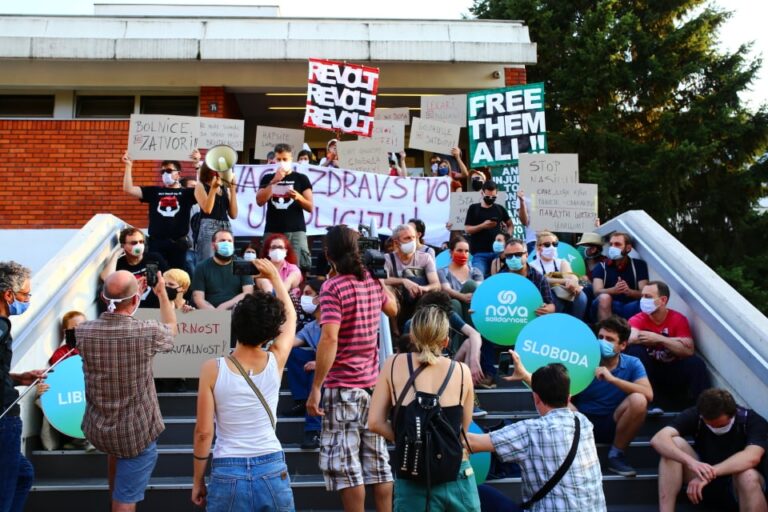
“It is our duty to be here, to show that we will not put up with injustice” and “We will be even louder until all political prisoners are released” are some of the messages activists of the Joint Action Roof over Your Head addressed the public with at Wednesday’s protest in front of the Misdemeanor Court in Belgrade.

The beginning of the week saw the dissolution of what started as the biggest protest in Serbia in a decade. Activist organisations and few opposition parties continue to demand the release of whom they claim to be unjustly jailed “political prisoners”.

Police brutality marks the first two days of protests in Belgrade, while the third protest goes on without incidents.

For two days in a row Serbian citizens have been protesting against their government and the new anti-pandemic measures the president had announced. Both on Tuesday and Wednesday afternoon the protests started peacefully, only to turn into a havoc of protester-police clashes and police brutality as the night fell. The alt-right is trying claim the lead and steer the riots according to their agenda. Meanwhile, some left wing organizations see the demonstrations as a spontaneous expression of people’s justifiable dissatisfaction with the government and long accumulated anger.

Protests in Serbia erupted on July 7 after president Aleksandar Vučić announced that the government will reintroduce heavily restrictive measures due to the bad epidemiological situation in the country. During his announcement the president put blame on the citizens for the acute health crisis. The protests continued last night in several cities in Serbia. Similarly to the first night, there were riots and brutal police violence.

About 50 members of the “Levijatan” and “I live for Serbia” far right movements gathered yesterday in front of a migrant centre in Obrenovac near Belgrade, into which their comrade-in-arms, Filip Radovanović, forced his way by car last week. Filipović was arrested on the occasion.

More than 100 people gathered at a protest organized by right-wing organizations on Sunday, including participants of so-called “national patrols” that intercepted migrants in downtown Belgrade.

Postmen protested today in front of the main post office in Novi Sad. Post of Serbia workers don’t give up on their demand for better material position and fight against the increasing pressure exerted by management and the authorities.

A protest of support for the people of Rojava was held in front of the Turkish embassy in Belgrade yesterday.

Climate strike march took place in Belgrade last Friday under the slogans: “Wake up and join! The young demand changes!” A few hundred people, most of them young, gathered at the Terazijska česmafountain, demanding climate politics which will keep global warming within the acceptable limits. The gathering was organized by Fridays for Future Serbia and the Serbian Green Youth.

Couple of hundred citizens gathered in front of the Faculty of Philosophy in Belgrade on May 26. The reasons for their dissatisfaction are the new authorisations given to private enforcement officers and the criminalisation of solidarity. The demand of the protest organised by the United Action Roof over One’s Head (Združena akcija Krov nad glavom) is to protect the right to have a home.

Dveri, a party openly embracing Dimitrije Ljotić who was the leader of Serbian fascist movement Zbor, managed to get the most out of the radical right’s growth in Serbia. Now they show the potential to to gain the most out of the “1 in 5 million” protests led by Alliance for Serbia, a coalition of opposition parties.

International Women’s Day was celebrated in Belgrade with a Protest march under slogans “Work, not famine – food, not weapons!” and “If women stop the whole world stops”.

An immediate cease of construction of all derivative mini hydropower plants on Serbian territory was the only demand of the anti-MHP protest held in Belgrade on Sunday. Roughly four thousand people gathered at the Student’s square in Belgrade to protest the construction of such hydropower plants in Serbia. The protest was organised by “Let’s defend the rivers of Stara planina” (ORSP) initiative, together with “Savski nasip”, “Right to Water”, “Let’s Not Drown Belgrade” (NDMBG), “Students won’t give away rivers”, and other organisations.

Six years ago a wave of demonstrations broke out throughout Spain. What started as a protest against the widespread political corruption and the lack of “real” democracy soon spread to millions of people challenging the current political and economic order. This movement will have later come to be known as the Indignados, or the 15M movement. The main three slogans of the May 15, that were supported by almost 80% of the population, were: “You call it a democracy – but it’s not”, “It’s not a crisis, it’s a scam”, “We are not merchandise in the hands of the politicians and the bankers.”

The official organizers state that the protests in Belgrade are not political, but many people are taking to the streets under a different political message.

Hungary’s “slave law” is the government’s attempt to remedy existing labour shortage in the country for the benefit of multinational companies and to the detriment of workers. Industrial workers in general have not mobilized yet, but the trade unions announced and started preparation for strike actions.


