Blockade of the court building in Novi Sad

Finally Free: Mašina Speaks with Released Activists

Six and a half months. That’s how long members of the Novi Sad branch of the Movement of Free Citizens (PSG), Marija Vasić and Lado Jovović, along with STAV activist Lazar Dinić, spent in detention, both in jail and under house arrest. For almost two months, Dimitrije Dimić, a student in Niš, wore an ankle monitor. All of them are facing charges of organizing the violent overthrow of the constitutional order. But for the foreseeable future, they will (hopefully) be able to freely prove their innocence. Jovović, Dinić, and Dimić spoke to Mašina about the past months and their reactions to the courts’ decision to lift the previous restrictions.

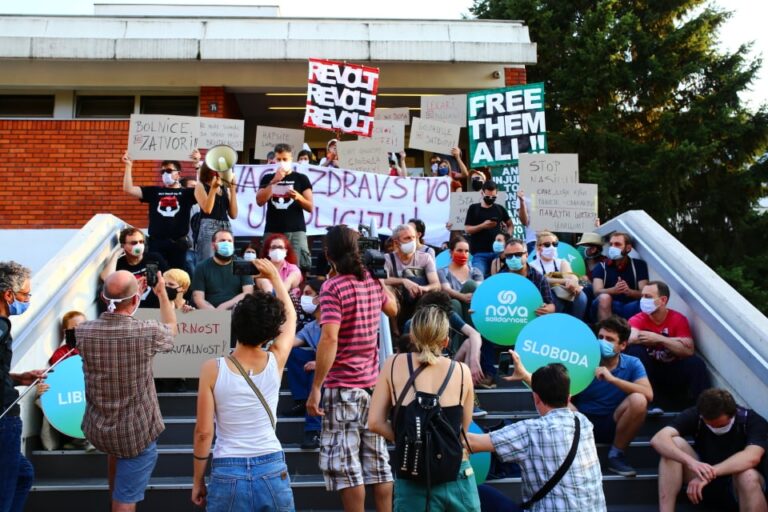
Six and a half months. That’s how long members of the Novi Sad branch of the Movement of Free Citizens (PSG), Marija Vasić and Lado Jovović, along with STAV activist Lazar Dinić, spent in detention, both in jail and under house arrest. For almost two months, Dimitrije Dimić, a student in Niš, wore an ankle monitor. All of them are facing charges of organizing the violent overthrow of the constitutional order. But for the foreseeable future, they will (hopefully) be able to freely prove their innocence. Jovović, Dinić, and Dimić spoke to Mašina about the past months and their reactions to the courts’ decision to lift the previous restrictions.

House Arrest Lifted for Three of Six Novi Sad Activists

Activists from the Free Citizens’ Movement (PSG) and the STAV organization, Lazar Dinić, Marija Vasić, and Lado Jovović, were released today from house arrest. They had spent more than four months confined to their homes following two and a half months in jail. A decision is still pending for the other three activists involved in the same case, which began in March 2025, when authorities imprisoned them over an alleged coup plot based on an illegally obtained audio recording.

Activists from the Free Citizens’ Movement (PSG) and the STAV organization, Lazar Dinić, Marija Vasić, and Lado Jovović, were released today from house arrest. They had spent more than four months confined to their homes following two and a half months in jail. A decision is still pending for the other three activists involved in the same case, which began in March 2025, when authorities imprisoned them over an alleged coup plot based on an illegally obtained audio recording.

Psychological warfare in Serbia: Nearly 1,000 detained without convictions

The grassroots initiative “Release them ALL!” has published a database showing that since November 1, 2024, over 900 people have been detained. On the other hand, the number of criminal convictions is negligible. Mašina spoke with Lawyers Rodoljub Šabić and Ivan Ninić on this phenomenon. The vast majority of these arrests are resolved within 48 hours, often without indictments being filed – which the initiative believes serves as a way to exhaust and intimidate protestors. The full database is available at this link.

The grassroots initiative “Release them ALL!” has published a database showing that since November 1, 2024, over 900 people have been detained. On the other hand, the number of criminal convictions is negligible. Mašina spoke with Lawyers Rodoljub Šabić and Ivan Ninić on this phenomenon. The vast majority of these arrests are resolved within 48 hours, often without indictments being filed – which the initiative believes serves as a way to exhaust and intimidate protestors. The full database is available at this link.

Clashes in Novi Sad

Students’ Analysis Finds Police Used More Dangerous Gas Against Protestors

An independent laboratory analysis conducted by students of the Faculty of Sciences (PMF) in Novi Sad shows that at a protest on September 5, police officers deployed chlorobenzylidenemalononitrile, known as CN gas. CN gas is a more dangerous variant than the usual tear gas, chloroacetophenone which is known as CS gas.

An independent laboratory analysis conducted by students of the Faculty of Sciences (PMF) in Novi Sad shows that at a protest on September 5, police officers deployed chlorobenzylidenemalononitrile, known as CN gas. CN gas is a more dangerous variant than the usual tear gas, chloroacetophenone which is known as CS gas.

Protest in New Belgrade

Tear Gas and Defiance: Serbia’s Streets Erupt Against State Violence

Tear gas, smoke bombs, police beatings, and the military. The second day of mass protests in Serbia has been marked by arrests, police brutality, attacks on journalists and government impunity. However, citizens do not appear to be backing down. What exactly has transpired on the streets of Serbia these past three days?

Tear gas, smoke bombs, police beatings, and the military. The second day of mass protests in Serbia has been marked by arrests, police brutality, attacks on journalists and government impunity. However, citizens do not appear to be backing down. What exactly has transpired on the streets of Serbia these past three days?

Masked Men Violently Evict Students in Novi Pazar; Students Retake Building

All day, police blocked the entrance to the State University in Novi Pazar (DUNP), a Muslim-majority city in southeastern Serbia. In the early hours this morning, masked individuals forcibly removed student protesters from the building, leaving one student injured. As students from across the country flocked in support, students regained access to the building and chanted "Victory!" Citizens are now organizing protest blockades across the country in solidarity.

All day, police blocked the entrance to the State University in Novi Pazar (DUNP), a Muslim-majority city in southeastern Serbia. In the early hours this morning, masked individuals forcibly removed student protesters from the building, leaving one student injured. As students from across the country flocked in support, students regained access to the building and chanted “Victory!” Citizens are now organizing protest blockades across the country in solidarity.

More Baseless Arrests: Escalating Repression Breeds Fiercer Resistance in Serbia

30 days of detention have been ordered for nine residents of the western city of Užice following protests during which citizens broke through the police cordon. Ahead of the St. Vitus protest on June 28, police detained eight other individuals and accused them of planning to potentially "undermining the constitutional order" – in other words, terrorism. Seven of them received the same sentence as those from Užice. In total, 16 people are currently behind bars, three of whom are students. Through this move, the Serbian government demonstrated its intent to again apply the methods it used in Novi Sad, where six activists were detained on similar charges in March 2025. However, as it turns out, the public’s response to such heightened repression and oppression is heightened resistance.

30 days of detention have been ordered for nine residents of the western city of Užice following protests during which citizens broke through the police cordon. Ahead of the St. Vitus protest on June 28, police detained eight other individuals and accused them of planning to potentially “undermining the constitutional order” – in other words, terrorism. Seven of them received the same sentence as those from Užice. In total, 16 people are currently behind bars, three of whom are students. Through this move, the Serbian government demonstrated its intent to again apply the methods it used in Novi Sad, where six activists were detained on similar charges in March 2025. However, as it turns out, the public’s response to such heightened repression and oppression is heightened resistance.

Government Influence and Academic Resistance in Serbia

As the government seeks to strike a deal with the University of Belgrade’s administration in order to break the student uprising, professors and teaching staff have mobilized to keep higher education a public good. But as resistance intensifies, so too does repression.

READ
