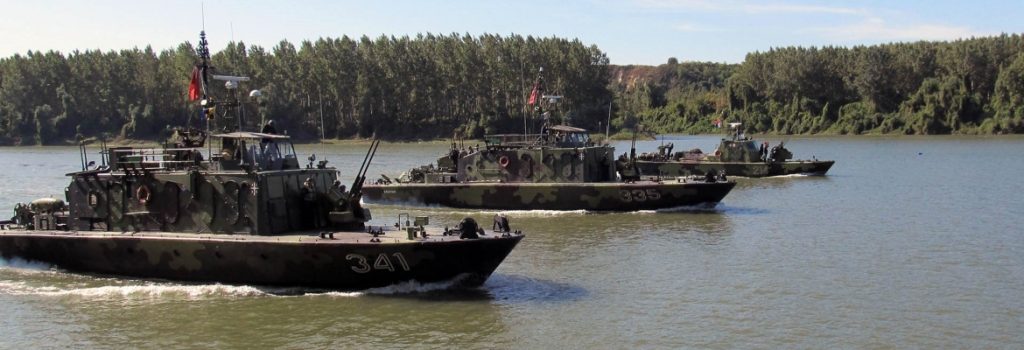

The military parade titled “Strength of Unity”will mark the recently established national holiday Day of Serbian Unity, Freedom, and the Flag (September 15), and will be held on Saturday, September 20 from 11 a.m. in Belgrade.
Preparations for the parade have been underway for several weeks as residents face heavy traffic and military planes flying overhead daily. The Serbian military leadership has announced that its most modern military equipment will be displayed that day in the neighborhood of New Belgrade.
Regarding the organization of the parade and the previous celebrations of the national holiday, Petar Bošković told Mašina that neither the parade nor the more relevant date of September 15 should be taken discounted. In his view, the government has done exactly that.
“Serbia certainly should commemorate September 15, because without the Thessaloniki fighters who helped defeat the Central forces in World War I, we would not have our own state today. However, the current regime is disregarding that date. Looking back, the parade could have been held on the Sunday before the holiday, which would have made more sense. However, since the President Aleksandar Vučić had obligations in Japan, he decided to adjust the national holiday to his schedule. Following the mantra: ‘The state, that’s me,’” Bošković tells us. He adds that it is interesting that Vučić himself announced the parade, meaning it was not planned in accordance with the military’s annual budget.
Do Serbians need a military parade?
Among the main questions regarding the parade is: if it is truly the largest in Serbia’s history, how much of the government’s resources financed by taxpayers will be spent organizing it.
According to Bošković, the sum spent amounts to millions of euros. However, he notes that there is a catch in that calculation.
“Our army is budgeted as if it is at full capacity, that is, at 100 percent strength, but we all know how many specialists are lacking in the system. And now, that money from the budget, which under other circumstances would go toward the salaries of officers, non-commissioned officers, and soldiers, is being used to finance this parade,” Bošković explains.
He emphasizes that this money could have been put to much better, more humane use.
“That money could have been directed toward ten thousand square meters of housing, because the army still has about 1,500 military families displaced from Croatia who do not have apartments and live in temporary accommodations. Finally, we also have examples like the Bristol Hotel. Or, for instance, that money could have been used to purchase four Canadair helicopters for firefighting, since currently we only have one such helicopter,” Bošković points out.
Ultimately, Bošković believes that, regardless of the parade’s cost, it is illogical for the government to organize such an event at a time during such an intense socio-political crisis.
“In Serbia, a state of emergency has been ongoing since the canopy of the railway station in Novi Sad collapsed. The people are deeply divided, students and war veterans are being arrested and beaten, and the regime is organizing a military parade. By doing this, the government is creating new divisions. And that polarization is the only thing the current regime knows how to enforce. The message, in my view, is clear: ‘No one is allowed to touch us.’ What is a military parade? It is a connection with the people because citizens have the most trust in the army, and Vučić wants to embrace that segment of society to boost his rating. At the end of the day, the point is for him to show strength and power,” Bošković concludes.
M.B.; A.M.


